






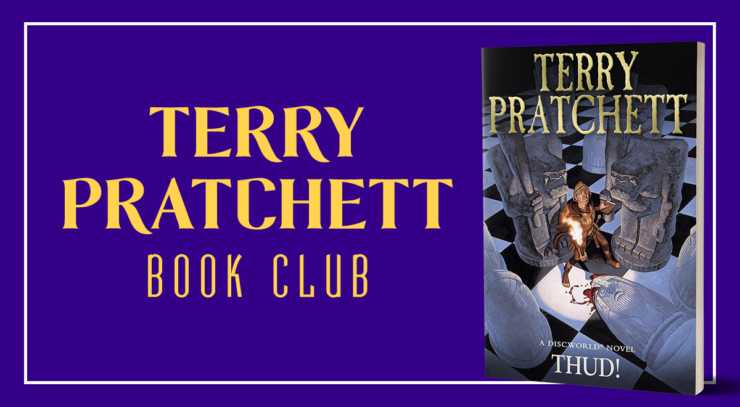
Vimes doesn’t much care for the game the book is named after… wonder if that’ll be relevant somehow.
Summary
There are historical texts and translations around early dwarf and troll cultures. And then a murder, witnessed by a troll. Sam Vimes is shaving himself and Willikins is reading out the important bits from the Times, one of them being the current “dwarfish situation” and the other being a piece about how the Watch is going to be interviewing a vampire. There has been a murder beneath the city and all the dwarfs who have come across the body agree that no one should speak of it, and also that it was committed by a troll. Vimes has a waiting mob at the Watch House to protest the potential appointment of a vampire while Otto is standing there to take pictures. Cheery has been promoted to sergeant and got Angua to bring the vampire interviewee in through the back, which has Vimes worried given the tension between vampires and werewolves. Angua is having difficulty with the vampire, one Sally von Humpeding, but shows her around. In the meantime, Vimes has to deal with a city inspector named Mr. A. E. Pessimal, who refuses to call him anything but “Your Grace.” Pessimal asks for an office and tells Vimes that he’ll need to interview officers. Fred has been moved over to custody officer at the Old Lemonade Factory and tells Vimes that he’s hearing things on the streets from the dwarfs, who seem tetchy, and has seen troll graffiti about someone called Mr. Shine.
Buy the Book
Under the Smokestrewn Sky
Vimes reads up on Koom Valley, an old fight between dwarfs and trolls that made their mutual hatred “official.” Saturday is Koom Valley Day, and it’s more tense than usual since Grag Hamcrusher arrived a month ago and started preaching that dwarfs were superior and it was their duty to wipe trolls from the earth. Vimes breaks up a fight in the canteen between dwarf and troll officers and tells everyone to get to their jobs and not mess about. He has to go interview Sally, then, which gets off on the wrong foot when he mentions it to Angua, not noticing that Sally is behind her. Fred and Nobby are walking along elsewhere, and Fred mentions that he met Nobby’s current girlfriend… at a local strip club. Fred thinks this isn’t appropriate, but Nobby is quite taken with Tawneee. The curator of the Royal Museum of Art stops them in the street to let them know that a famous painting—The Battle of Koom Valley—has been stolen. They find that it’s been cut out of its frame, and learn about the painter, who worked on the piece for over fifteen years while he was poor and constantly moving about and maybe going a bit mad. People believe that there’s a secret hidden in the painting, but no one can agree what the secret is, and there’s a book for those interested in the mystery: The Koom Valley Codex.
Vimes does his interview with Sally, which doesn’t go well, but he decides to hire her anyway on probation. As they’re finishing up, Carrot bursts in to tell him that someone’s killed Grag Hamcrusher. Vimes learns that the dwarfs were planning on keeping all this a secret and that Carrot only found out because one of the dwarf officers is keen on being promoted. Vimes knows that this is sensitive, but he wants to drop by to ask after Hamcrusher and at least try to confirm if the murder is true. The deep-down dwarfs are wary of Carrot and Cheery, but Vimes insists on bringing Detritus in his crew regardless. On the way, he’s reminded by his new Dis-Organizer that he’s meant to sit for a family portrait, and has to send an officer to give Sybil his regrets (again). They arrive in the street and Angua can feel a thudding below, shaking the area. Vimes tells the guards at Hamcrusher’s house that he wants to see the dwarf and is told he’s not seeing anyone; knowing that he’s dead, Vimes asks the guards to ask someone in authority what should be done next—or he plans to bring Dorfl in to break the door down. They try to wait him out, but finally have to let him in with Angua. Eventually, they are greeted by a dwarf called Helmclever, who is the “daylight face” of this group.
Vimes finds that he has a copy of The Koom Valley Codex and demands that Helmclever let him see Hamcrusher’s body. Someone new emerges named Ardent, and Vimes and Angua are both brought to his office. He admits that Hamcrusher was murdered and insists that they are handling the issue. He also insists that a troll committed the crime because a troll’s club was found by the body. Vimes tells him that this is absurd and demands to see the other grags. Ardent insists that they won’t speak to him, that his joke to the Low King in Uberwald about being a blackboard monitor is a crime to true dwarfs—Vimes erased words. Vimes tells Ardent that if he won’t allow it, they’ll essentially be declaring war against the city, so Ardent agrees to take him. As they’re heading down, Vimes gashes his hand on a nail or rivet. Far off, a troll named Brick who is frequently high on Scrape vaguely remembers wandering into a hole and it turning out to be a dwarf place. When Vimes emerges from the mines (having gotten access to the crime scene for Carrot), a bystander throws a brick at dwarf officer Ringfounder; Detritus catches the brick-throwing dwarf and they arrest him. Heading back to the Watch House, Otto is there and ready to get a picture of Detritus holding the dwarf in the air. Carrot tells Vimes that the symbol he saw Helmcleaver draw in coffee is a reference to “The Following Dark,” which is… not good.
Commentary
This story is deceptively layered, when you get right down to it. It’s about prejudices and racism (or the allegorical fantasy equivalents), but it’s also about Sam Vimes’ own issues with control and how a belief in justice might be practiced in manners that are decidedly unjust.
What I’m saying is, it’s incredibly pointed that all of this is happening while the Watch is undergoing a city inspection, that Vimes thinks that said inspection should never be a thing, and that it’s coming on the heels of Vetinari having seen Vimes cross a line where Carcer was concerned in that cemetery in Night Watch. Basically, the Patrician is silently stating in no uncertain terms that Vimes’s claims as the person who watches the Watchmen are no longer sufficient, given the amount of power (and money) they wield. He’s right, even if the audit will turn up more than a fair share of silly concerns. He’s also right that Vimes cannot make his one diehard prejudice a policy within his sector, and that hiring a vampire is important.
But because these stories set no store by black-and-white thinking, the problem of Hamcrusher’s murder is incredibly wooly in all sorts of ugly ways. Large cities frequently have to deal with populations of people who want to create their own mini societies within the confines of those metropolises. The usual bottom line in those scenarios is that if you want to live somewhere with different laws than you’re accustomed to, you have to abide by them. That doesn’t stop some groups from trying to skirt those laws any more than than the general population often does (because that factor often gets left out of the conversation—plenty of folks flout laws, for all manner of reasons).
What Vimes is coming up against—what’s making him angry, and that’s a key factor in this—is that the deep-down dwarfs believe that their own home laws should apply in his home, and that they are acting constantly without any care for the other citizens around them. And while his anger is understandable, particularly where that last bit is concerned, it is still something that should be kept firmly out of his job. He knows that. But knowing it and enacting it are two different things.
Vimes immediately resorts to intimidation in this scenario. And yes, it’s because there has been a murder and he’s right that the dwarfs shouldn’t be allowed to hush it up from everyone else. They certainly shouldn’t be allowed to blame another species on weak circumstantial evidence to stoke racial tensions higher in the city. And it’s also relevant that Vimes tends toward an altogether fairer code than nearly anyone around him—it’s so, so pointed that Carrot is the one who suggests separating trolls and dwarfs on patrols, and that he’s a person who is often considered more good than goodness allows, and that this line of thinking is still entirely wrongheaded. Vimes knows that, too, and never considers following the suggestion because he understands that Carrot’s desire to keep people comfortable at all cost is preventing him from making good recommendations.
But Vimes still sits down on Hamcrusher’s stoop and threatens his people.
He does it in service of justice and he ultimately gets what he’s aiming for and what’s needed—the city finds out for sure that Hamcrusher is dead and he gets Watch access to the crime scene so they can hopefully solve the crime for real. But he still got all of that by amiably chatting with the guards and letting them know that if they didn’t cooperate, he would storm the premises with extreme prejudice using Constanble Dorfl. The use of coercion and intimidation to receive cooperation—even for something as heinous as murder—can only ever be wrong. Claiming to keep the peace by threatening to destroy it on a smaller scale doesn’t math out.
What the deep-down dwarfs are doing is also wrong, though; the way they treat anyone identifying as female as lesser, digging beneath the city without any consideration for the people above (who they barely believe are real to begin with—which is also wrong, no matter your cultural views), blaming a troll for Hamcrusher’s murder. But while the saying “two wrongs don’t make a right” is trite, it’s still getting at an ultimately true point: Trying to fix someone’s wrongs by committing your own is a quick and easy way to begin justifying all manner of atrocities. It’s better not to start.
As a side note, it only just now occurred to me how painstakingly Pratchett describes darkness, almost as an antidote to movie candlelight; we’ve all watched in films and television how one tiny candle can illuminate untold caverns of darkness. It’s sort of similar to how movie fires let you see everything in a room that should be nothing but smoke. Whenever dwarfen spaces are described in these books, whenever you’re in true darkness, the narrative is clear that no tiny amount of light is going to penetrate anything. That picking out details will be impossible and everything will be rendered in the strangest tones of gray and shadow.
Asides and little thoughts:
- “He knew in his heart that spinning upside down around a pole wearing a costume you could floss with definitely was not Art, and being painted lying on a bed wearing nothing but a smile and a small bunch of grapes was good solid Art, but putting your finger on why this was the case was a bit tricky.” Good old Fred, coming in with the classic “I don’t know how to define pornography, I just know it when I see it” argument.
- Obviously all the references to people coming in to measure the painting and puzzle out what it means are in reference to The Da Vinci Code, which had been published a couple years ahead of Thud! and was massively (and somewhat annoyingly) popular at the time.
- Wow, the technology section here being just a gorgeous lesson in obsolescence: Vimes’ next Dis-Organizer is called the “Gooseberry,” now the most hilariously dated Blackberry joke ever made. Bluenose messaging works, however, because Bluetooth is more prevalent than ever. And then there’s iHUM, which… iPods vanished about a decade after this book came out, though iTunes still exists. Wild.
Pratchettisms:
Mr. Pessimal folded himself onto the chair in front of Vimes’s desk and opened the clasps of his briefcase with two little snaps of doom.
Vimes considered the admissibility of Fred Colon’s water as Exhibit A.
Now the melting pot was full of lumps again.
“That is certainly one of the theories,’ he said, speaking carefully, as people tended to after hearing the Colon-Nobbs Brains Trust crossing purposes.
Vimes sighed. He hated games. They made the world look too simple.
On the ceiling above them, vurms congregated, feasting on spittle and rage.
“You talk to bad dreams on their behalf?”
Next time we’ll read up to:
For Brick, everything went dar—


Thoughts
At the start of the book, Vimes has only two “demons” in his head to deal with – a desire to drink and desire to do violence. This section hints that there may be more to come.
Vetinari has “views” on modern art, which I tend to agree with. Colon and Nobbs OTOH are more concerned with what objects are required to indicate that it’s okay to ogle nudes.
Colon wants to get assigned to the museum theft because it will keep them off the streets during Koom Valley day. I can’t help but think that somehow this assignment will become significant.
Pratchettisms
“Anyvay, I couldn’t tell you even if I knew, because of zer Freedom of the Press.” “Freedom to pour oil on a flame, d’you mean?” Vimes demanded. “Zat’s freedom for you,” said Otto. “No-vun said it was nice.”
“Nevertheless,” Vetinari had said. Just “nevertheless.” You couldn’t argue with “nevertheless.”
When the dwarf bars and the trool bars emptied out in the evening, hell went for a stroll with its sleeves rolled up.
“After he viewed Don’t Talk to Me About Mondays!, Lord Vetinari graciousleah had Ms. Pouter nailed to the stake by her ear,” said Stitched.
They started to give Vimes the look of all guards everywhere, which, in summary, is this: The default position is that you’re dead; only my patience stands in it’s way. But Vimes was ready for it. Any five hells you cared to name knew that he’d used it himself often enough. He counted with the aloof expression of someone who didn’t notice guards.
The dwarf probably knew a lot about iron but nothing about irony.
Good old Cherry. She knew what a Vimes BLT was all about. It was about having to lift up quite a lot of crispy bacon before you found the miserable skulking vegetables.
“Cogito ergo sum, Insert Name Here. I exist, therefore I do sums!” (Gooseberry) IMO, one of the best puns Pratchett ever made.
Shoutbacks
Recalling Tiffany in A Hat Full of Sky, Sally tells Vimes that she can’t turn into a bat but she can turn into a lot of bats because she has to account for body mass.
Do not…what do they call it…go postal? (Vimes)
Random Notes
Sally (Sally Bowles from Cabaret?) von Humpeding (Engelbert Humperdinck who wrote the opera Hansel and Gretel?)
This is a … fraught … time to be reading this particular book (which probably had other interethnic disagreements in mind, given how recent the major troubles in formerly-Yugoslavia were when this was written.
I’m not sure I agree with the argument that I’ll summarize as “force is always wrong.” Is Law helpless in the face of lawlessness? Obviously there is a lot of room for stupidity (Pratchett possibly also knew of the overreaction to an alleged pillbox on a Philadelphia rooftop), but at what level does flouting Law become a matter for what level of action? (And some of this is probably my own reaction to religious extremism anywhere….)
It is possible that Pessimal is just a stale joke about management consultants, or a nuisance that Vetinari gets out of the way by pawning him off on someone impervious. It’s also possible that Vimes will learn something (beyond patience…).
Some Pratchettisms:
He looked funny, a joke, a music-hall vampire. It had never previously occurred to Vimes that, just possibly, the joke was on other people. Make them laugh, and they’re not afraid. Just one step removed from “He who’d make his fellow creatures wise/Should always gild the philosophic pill.”
It creaked open. Any door opened by an Igor would creak. It was a knack. And it doesn’t even need Foley.
Standing around watching people was, of course, Ankh-Morpork’s leading industry. The place was a net exporter of penetrating stares.
Vimes didn’t mind the countryside if it stayed put and didn’t attack. cf “The Ploughboy and the Cockney”?
@1: I’m not sure either of those was intended; Salacia seems to be earnest rather than either cynical or saccharine. Alas that we can’t ask….
He looked funny, a joke, a music-hall vampire. It had never previously occurred to Vimes that, just possibly, the joke was on other people. Make them laugh, and they’re not afraid?
And of course that’s a pretty good summary of most of Pratchett’s ouvre – make them laugh, and let the different way to think of the world sneak into their heads.
I have tattoos on my arms because of this book.
Lots of other reasons, but this was the inspiration behind them.
“Could I please read a book in 2018 that was not written in 2018 and doesn’t feel like it’s about 2018?” — Mark Oshiro, plaintively, while reading this book
I hate how Colon, and later Sally and Angua, treat Nobby’s relationship with Tawnee. Colon simultaneously thinks that Nobby is too good for Tawnee (she works a disrespected job) and Tawnee is too good for Nobby (she’s beautiful). Sally and Angua think the latter as well. Accordingly, they all strive to interfere with it.
Colon says Nobby had “no dad to set you on the proper path,” morally. Wrong. Nobby had a horribly abusive, neglectful dad who put him on a path of poverty and crime that Vimes fortunately tempered.
“[Precious Jolson] has the muscles of a troll.” Nah. You can have the strength of a troll, but you can’t have the muscles of a troll because trolls don’t have muscles. :p
Discworld Dwarfs traditionally consider “dwarf” identity to be more about mindset and culture than birth or stature. This means a born human raised by dwarfs can be truly considered a dwarf by himself and others. But it also means that a born dwarf who strays from that culture and mindset can be considered to have lost their dwarf identity altogether.
Pratchettisms:
“[…] but I’ll drop like a ton of rectangular building things on any copper who tries a bit of historical re-creation in the locker room.” — Vimes
“Well, keep listening, Fred. I’m replying on you not to let a buzz become a sting.” — Vimes
‘What they saw was a tableau in various shades of guilt.’
Nobby: “I know you like to point the finger of scoff, Sarge, but there’s a lot that goes on that we don’t know about.”
Colon: “Like what, exactly? Name me one thing that’s going on that you don’t know about. There, you can’t, can you?”
‘The important thing is not to shout at this time, Vimes told himself. Do not — what do they call it? — go postal. Treat this as a learning exercise. Find out why the world is not as you thought it was, assemble the facts, digest the information, considering the implications. But then go postal. But with precision.’
Looking back:
Doreen Winkings, pretending to be a vampire, is one of the Black Ribboners who (in a flashback) had pressured Vimes to have a vampire in the Watch. She and her vampire husband Arthur played a significant role in Reaper Man.
‘The [Koom Valley Day] parades were OK. The Watch had gotten good at keeping them apart.’ A feat first done in Men at Arms, by Carrot.
“That pea-brained idiot at the post office has gone and issued a Koom Valley stamp.” Possibly a reference to Stanley who, presumably unbeknowst to Vimes, was allegedly “raised by peas.”
Vampires in Ankh-Morpork now tend to carry a kit with a brush, dustpan, vial of animal blood, and explanatory card, in case they’re turned to dust by light. Otto first began carrying a blood vial in The Truth, at someone else’s suggestion (I forget who). I wonder if he starred the trend, or if other vampires got the same idea.
Looking ahead:
It’s mentioned that Vimes has an estate in the country and has never visited it. I don’t remember if this has been mentioned in earlier books, but it will be the focus of the next Vimes book.
@6 – Nobby
Between Colon and Nobbs, Nobbs has always been the brains of the outfit and the morally superior one. He didn’t learn morals from his father or from Colon but from his surrogate father, Vimes (maybe we should call him Uncle Sam). :)
ISTM that Colon’s basic problem is that he doesn’t want Nobbs to have any life that he can’t control. But I’m not sure why Pratchett had Sally and Angua making comments as well.
@6,
I think Each arises suggests the “emergency b-word.”
Because they are certain Tawnee can do better than Nobby Nobbs. He’s a better person than Fred Colon, yes, but this is a bar so low it could be used for a limbo contest in the King Rhys’ throne room, and does not make him a desirable romantic partner. Sally and Angua would prefer to see Tawnee (and indeed any woman of any species) with a man who has, for example, not only heard of the idea of personal hygiene but practices it on a regular basis.
@6 et al – Sally and Angua don’t make these comments until next week on our reread. To put it in a bit more context (and I think this is a minor spoiler but I’ll mark it anyway)
Angua is extremely jealous of Sally’s ability to always appear perfectly groomed. Sally also comments on Carrot’s attractiveness. Angua wonders if she will lose Carrot to her because he could do better.
@6: Discworld Dwarfs traditionally consider “dwarf” identity to be more about mindset and culture than birth or stature. And therein lies the problem: who defines that culture and mindset? [many real-world examples, deleted so this comment doesn’t get removed.] For almost every format that depends on an abstract definition, there will be somebodies who say the format is too loose; the attitude of the dwarfs of the darkness toward Carrot is the least of the examples in this book. That’s why Oshiro’s complaint doesn’t move me; 2018 is just a speck in the list of years to which this book is applicable. I would call that a strength rather than a weakness; many books become irrelevant, even though we wish others would.
IMO a choice between Colon and Nobby is no choice at all; Colon is a parody-type of a cop, but Nobby will steal anything from anyone — including IIRC fellow Watch — if it’s sufficiently convenient. Neither is quite as bad as originally shown, but neither has grown nearly as much as Vimes.
I knew that Pratchett had worked in Bristol (for the Western Daily Press), but I’d not ever thought before if his time here had any impact on his writing.
I’m going to have to think more on it, but I imagine coming from his rural upbringing to a big(ish) city would have sparked ideas in his head about the struggles of racial integration, which has a shaky history in Bristol.
Sometimes I think we think too much, trying to pin Pratchett down. In my opinion, when he writes of war in Jingo or Monstrous Regiment he is speaking of war in general. Likewise, when he speaks of prejudice he is writing of generic general prejudice or of generic religious prejudice. Pratchett tries very hard not to make it specific, just wrong.
Vimes thinks: “Would A. E. Pessimal understand if Vimes explained that Nobby’s services over the years more than made up for the casual petty theft, which you accepted as a kind of mild nuisance?”
What are Nobby’s services? The only specific thing I can think of is he tends to get around and pick up rumors and information that is occasionally useful to Vimes. Other than that, ISTM that he is no more than an incompetent watchman.
@14 – Nobbs (and Colon) are, indeed, incompetent watch men but they are excellent listen men. Vimes has become increasingly divorced from the streets as the Watch and his rank have grown.
He uses Nobbs and Colon to listen to Ankh-Morpork and give him a sense of how the city is feeling. They can accomplish this because everyone views them as incompetent and of no consequence.
In this book they have been through many Koom Valley Days but sense that this one is going to be far worse. They are also good at odd, not quite legal, jobs. Also comic relief.
Also, Nobbs is personally responsible for finding out the location of the Klatchian army in Jingo, which I think could buy you a lot of forgiveness. He’s also one of the lilac fighters in Night Watch.
@@@@@12: on top of that the state he lived in was embroiled in a low-grade civil war for his entire adult life*, a civil war whose tensions post-peace deal were often most visibly expressed through parades (link from 2001), but I think davep1 @@@@@ 13 has more of the right of it.
* Pratchett turned 21 the year British troops were deployed in Northern Ireland
“coming on the heels of Vetinari having seen Vimes cross a line where Carcer was concerned in that cemetery in Night Watch.”
I thought the whole point was that Vimes DIDN”T cross the line, he arrested Carcer despite goading, extreme temptation, and believing they were alone. Maybe Vetinari wants to remind him he is watched, or thinks some paperwork needs to be reviewed, but I thought Vimes stayed within the law and that was the point.
” Claiming to keep the peace by threatening to destroy it on a smaller scale doesn’t math out.”
I don’t think that is a fair reading of the situation. If Vimes was threatening someone before a crime was committed or threatening an innocent witness your logic would apply. But here the peace is already broken, someone was murdered. He was trying to administer justice and restore the peace. But someone is obstructing justice, aiding and abetting a murder after the fact. The guards can allow the watch to investigate the murder, or they can assist the murder by keeping the watch out. If they assist the murder, Vimes has the legal right to use force. So he is explaining to the guards what will happen if they deny access to the crime scene, rather than actually doing it. Explaining to someone the legal consequences of their actions isn’t breaking the piece or unjust, its far more merciful and wise resorting to force immediately.